

The Early reeds database does not allow us, unfortunately, to display the fields of metadata in languages other than French. The following notes are here to guide the English-speaking user to use the base and fill the fields of the reed register and keep a consistent system of description.
Pour le guide en français, cliquez ici.
General information
Identifiant de l’item dans la base de données – Item identifier in the database. Choose an identifier that contains the name of the instrument and another identifying data (for instance, the place where it is kept or the name of the maker). For items pertaining to the same series, use the same identifier with different numerals (for instance HautboisDesjardins1, HautboisDesjardins2, etc.). For musettes, the identifier of the instrument in the musette inventory by Vincent Robin shall be indicated.
Type d’instrument – Type of instrument ; indicate preferably in French (musette, hautbois, basson, etc.)
Période de fabrication – Manufacturing period
Lieu de conservation – Location of repository
Cote dans le catalogue – Catalog reference (for public collections) of the reed or the instrument with which it is kept
Statut de conservation (complète / incomplète / perdue) – Conservation status (complete / incomplete / lost)
Instrument associé – Associated instrument, in case the reed comes along with a known instrument. In that case, indicate all relevant informations about the instrument (location, measurements, pitch, maker, etc.). If you have a photo of the instrument, you can upload it as an attachment.
[pour les anches de musette seulement] partie de l’instrument à laquelle est destinée l’anche – [for musette reeds only] part of the instrument to which the reed is destined (bourdons, chalumeaux)
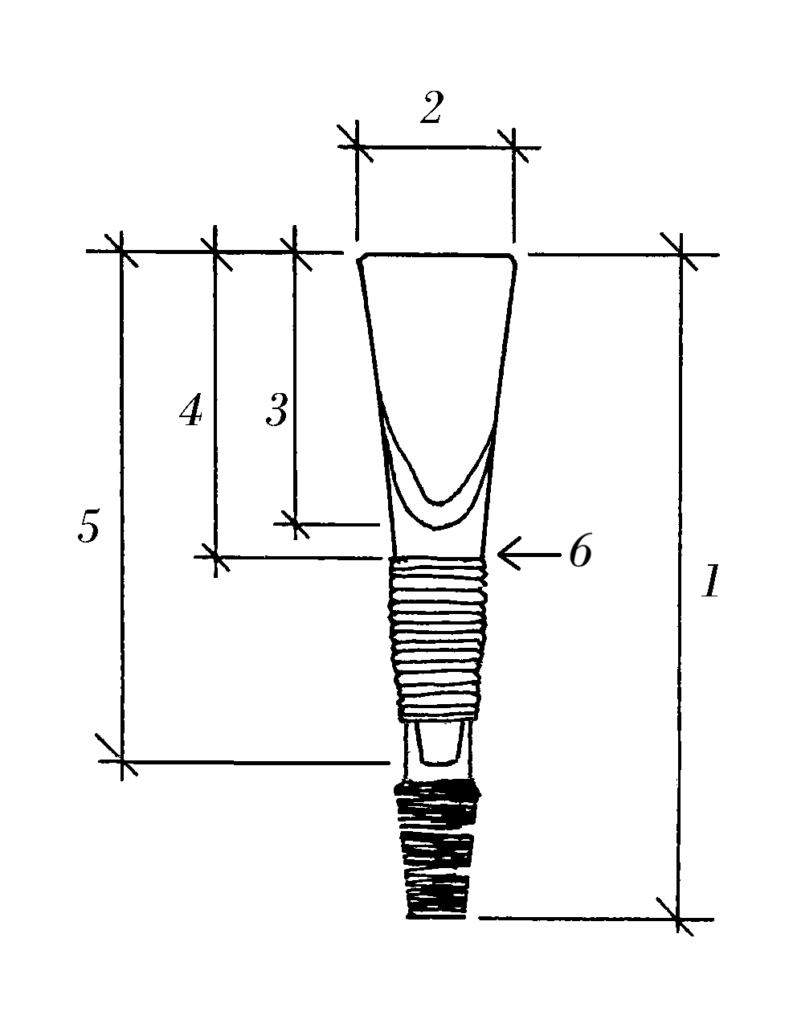
Measurements (all measurements are given in millimeters).
Longueur totale – Total length of the reed (value 1 on the example)
Largeur en haut des palettes – Width at the top of the reed blades (value 2 on the example)
Longueur du grattage [il y a deux valeurs pour chaque anche : une pour chaque côté de l’anche] – Length of the scrape [there are two values for each reed: one for each side of the reed] (value 3 on the example)
Longueur des palettes à partir du haut de la ligature en fil – Length of the reed blades from the top of the wire ligature (value 4 on the example)
Longueur totale des palettes – Total length of the cane blades (value 5 on the example). This can be measured accurately only when the thread does not cover the lower tip of the cane blades. If the thread goes over it, it can be guessed by observing the thickness of the profile.
Largeur des palettes au niveau de la ligature – Width of the cane blades measured where the thread stops (point 6 on the example).
Longueur du tube – Length of the staple, preferably measured from the inside of the reed (use a little hook for that).
Matière du tube – Material of the staple
Diamètre intérieur du tube à la sortie – Inner diameter of the staple at the bottom of the reed.
Dimensions de l’œil du tube – Dimensions of the top of the staple. This can be accurately measured only when the reed is dismantled or when only the staple survives.
Épaisseur du métal du tube – Thickness of the staple’s metal
Tube soudé (Oui / non) – Is the staple soldered ? (Yes / No)
Ligature métallique (Oui / non) – Is Is the reed wired with a metallic ligature/bridle ? (Yes / No). Other informations about the wire (where is the wire placed? What is the material and thickness? can be added in the « Autres remarques » field)
Auteur des mesures – Author of the measurements
Autres remarques – Other remarks (for instance, measurements that do not fit the frame, or comments on the measurements, the condition of the reed, its provenance, etc.).
Bibliographie – Bibliography (if the reed or the instrument has already been mentioned or described in an earlier published work).